
Treatment Planning & Risk Analysis in Implant Dentistry: A Practical Framework Before Hands‑On Training
Implant therapy succeeds most predictably when the plan is prosthetically driven, risk-aware, and individualized. Treatment planning is not a “pre-surgical formality”; it is the clinical decision process that determines whether the case should be treated with an implant at all, what timing and augmentation are needed, and how the restoration will be maintained long-term. Contemporary discussions in implant dentistry emphasize structured planning that integrates diagnosis, site and patient risk, and restorative goals.
1) Start with the end: Prosthetically driven planning
Define the restorative objective before selecting the implant position. For single-tooth gaps, the target emergence profile, occlusal scheme, and cleansability should guide implant diameter/position and tissue management. In practical terms, start with a diagnostic wax-up or digital plan, then work backward to surgical positioning and guide design. This “restoration-first” mindset is repeatedly highlighted as central in modern implant planning.
2) Patient-level risk analysis (systemic + behavioral)
A concise risk screen before CBCT interpretation often changes the plan:
-
Periodontal susceptibility/history: active or uncontrolled periodontitis increases biological complication risk and demands stabilization and maintenance planning.
-
Smoking and poor plaque control: elevate biological complication risk; they also determine whether a patient is suitable for complex protocols.
-
Diabetes and systemic control: rather than “diabetes yes/no,” focus on metabolic control and compliance with recall (local protocols may vary).
-
Parafunction (bruxism), high occlusal load, and prosthetic risk: influences implant number, splinting strategy, material choice, and protective measures.
A practical way to document this is to classify each domain as low/moderate/high risk and ensure the surgical and prosthetic plan explicitly addresses the high-risk items (e.g., phased approach, delayed loading, additional implants, protective occlusion, intensified maintenance).
3) Site-level analysis (hard and soft tissues)
Site assessment should be systematic:
-
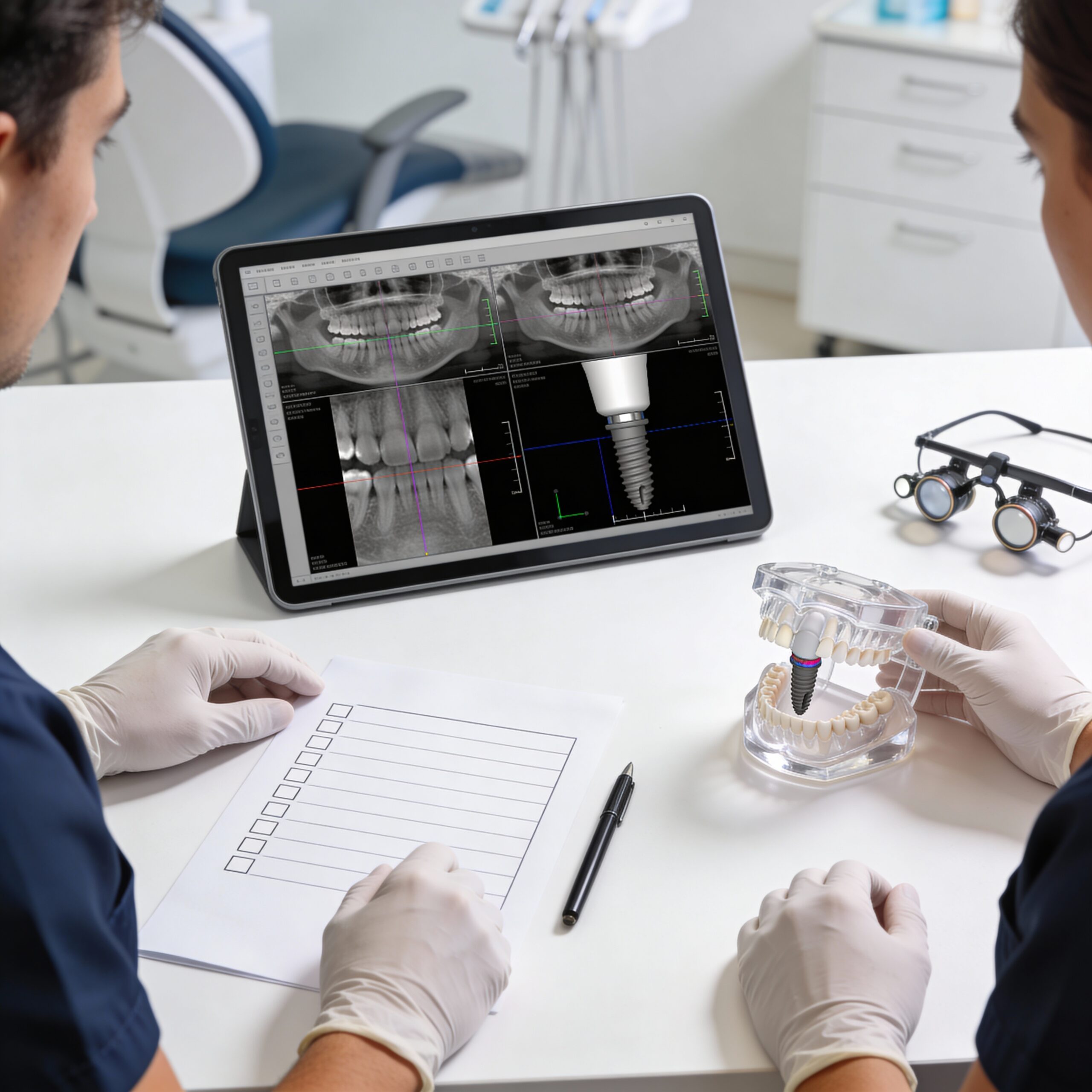
Bone volume and anatomy: evaluate available height/width, angulation, proximity to vital structures, and expected implant positioning relative to the restorative envelope. CBCT is commonly used for this stage, but interpretation must be tied to the prosthetic plan—not “implant fit” alone.
-
Bone quality and primary stability: influences drilling protocol, implant design selection, and immediate vs delayed loading decisions.
-
Soft tissue phenotype and keratinized tissue: impacts hygiene access, long-term mucosal stability, and the likelihood of recession, especially in esthetic zones.
When deficiencies are identified, the plan should specify whether to: (a) change implant position/size, (b) augment bone/soft tissue, (c) stage the treatment, or (d) select an alternative prosthetic option.
4) Timing and complexity: choose predictability over speed
Immediate placement/loading can be appropriate in selected cases, but risk analysis should determine whether the benefit outweighs predictability concerns. If primary stability, infection control, patient compliance, or tissue management is uncertain, a staged approach often reduces biological and mechanical complications. The key is not “immediate vs delayed” as a philosophy, but “indication-based timing.”
5) Restorative and maintenance plan (often underestimated)
Before surgery, specify:
-
Restoration type (screw-retained vs cement-retained) and how retrievability will be ensured.
-
Occlusal scheme and protective strategy for parafunction/high load.
-
Hygiene access design, patient education, and recall schedule. Long-term implant health depends heavily on maintenance protocols and patient adherence.
6) A simple decision checklist (chairside)
Use this short checklist to decide “go / modify / postpone / refer”:
-
Is the restorative endpoint defined (wax-up/digital plan)?
-
Are periodontal disease and plaque control stabilized?
-
Does CBCT-based site analysis support prosthetic positioning without compromising anatomy?
-
Is primary stability likely for the chosen timing/loading protocol?
-
Is a maintenance plan realistic for this patient’s risk profile?
If the framework above is clear on paper but harder to translate into predictable execution, structured hands-on mentorship is what typically closes the gap between knowledge and performance. Clinicians interested in supervised clinical workflows can explore BAIRD’s implant training pathways and course calendar.